
Website Maintenance Cost in India (2027): Plans, Pricing & What’s Included
Published November 23, 2026Updated November 23, 2026

- 1What Is Website Maintenance and What Does It Cover?
- 2How Much Does Website Maintenance Cost in India?
- 3Why do maintenance quotes vary so much?
- 4Website Maintenance Plans and Pricing: What Does Each Tier Include?
- 5How Does Website Maintenance Cost Differ by Platform?
- 6WordPress website maintenance cost
- 7Static and HTML website maintenance cost
- 8Shopify website maintenance cost
- 9Ecommerce website maintenance cost (WooCommerce and others)
- 10Custom, headless and modern framework sites
- 11What Are the Fixed Yearly Costs: Domain, Hosting, Email and SSL?
- 12Should You Pick a Monthly Plan, an AMC, Hourly Support or Pay Per Change?
- 13What Affects Website Maintenance Pricing?
- 14What Happens If You Do Not Maintain Your Website?
- 15DIY, Freelancer or Agency: Who Should Maintain Your Website?
- 16How Do You Choose the Right Website Maintenance Plan?
- 17Hidden costs to ask about
- 18Red flags
- 19What if your developer has stopped responding?
- 20Website Maintenance Checklist: What to Do Monthly, Quarterly and Yearly
- 21Does Website Maintenance Affect SEO and Google Rankings?
- 22Why Businesses Choose Awrange for Website Maintenance
- 23Website Maintenance Cost in India: Frequently Asked Questions
- 24How much does website maintenance cost in India per month?
- 25How much does WordPress website maintenance cost in India?
- 26What does Shopify or ecommerce website maintenance cost?
- 27How much does static or HTML website maintenance cost?
- 28Does a small website really need maintenance?
- 29What does a website maintenance plan include?
- 30Can I maintain my website myself?
- 31Are domain and hosting included in the maintenance cost?
- 32What is a website AMC?
- 33Does website maintenance include SEO?
- 34My developer is not responding. What can I do?
- 35How often should a website be maintained?
Quick answer: Website maintenance in India costs about ₹3,000 to ₹10,000 a month for a small business website, ₹8,000 to ₹25,000 for a larger business site, and ₹10,000 to ₹40,000 or more for an online store, plus 18% GST. Domain, hosting and SSL are usually billed separately.
Last updated: 23 November 2026. Written by the Awrange web team in Pune.
Most people treat a website like a one-time purchase. You pay the developer, the site goes live, and that feels like the end of it. Then a plugin update breaks the contact form, the SSL certificate expires on a Sunday, or the domain renewal email lands in a spam folder. Maintenance is the work that stops those things from happening.
This guide explains what website maintenance covers, what it costs in India in 2027, and how the price changes for WordPress, static HTML, Shopify and ecommerce sites. It also covers maintenance plans, hidden costs, and how to pick a provider without overpaying.
What Is Website Maintenance and What Does It Cover?
Website maintenance is the regular work that keeps a live website secure, fast, up to date and working. It includes software updates, backups, security and uptime monitoring, speed checks, form and link testing, content changes, and renewing the domain, hosting and SSL. It does not include building new pages or redesigns, which are separate projects.
Here is what a proper maintenance routine looks like, and how often each task happens.
| Task | What it does for you | How often |
|---|---|---|
| Domain and hosting renewal | Keeps the site online and the domain in your hands | Yearly |
| SSL certificate check | Prevents the “Not secure” warning that scares visitors away | Yearly, or automatic with good hosting |
| Core, theme and plugin updates | Closes security holes and fixes bugs | Monthly, or when a release is issued |
| Backups | Lets you recover after a hack, a bad update or a mistake | Daily or weekly |
| Uptime and security monitoring | Flags downtime, malware and suspicious logins early | Continuous |
| Speed and Core Web Vitals checks | Protects user experience and search rankings | Monthly |
| Form, link and checkout testing | Makes sure enquiries and orders actually arrive | Monthly |
| Broken link and 404 cleanup | Stops lost visitors and wasted crawl budget | Monthly or quarterly |
| Content changes | Keeps prices, offers, team photos and phone numbers current | As needed |
| Analytics and tracking checks | Confirms Google Analytics, Search Console and pixels still record data | Quarterly |
| Database and image cleanup | Stops the site slowing down as files pile up | Quarterly |
| Plugin and user audit | Removes unused plugins and old admin accounts | Quarterly |
| Restore test | Proves your backups really work | Yearly |
A small brochure site may only need the first half of that list. An online store needs all of it, plus payment and stock checks. We cover the cost differences in the sections below.
How Much Does Website Maintenance Cost in India?
Most Indian businesses pay between ₹3,000 and ₹25,000 a month to maintain a website. The exact figure depends on the platform, the number of pages, how often content changes, and how fast you need problems fixed. Personal blogs sit at the bottom of the range. Large stores and custom web applications sit at the top and beyond.
The table below shows indicative costs for a professionally managed plan in 2027. It excludes 18% GST and assumes domain and hosting are billed separately.
| Type of website | Monthly cost (₹) | Yearly cost (₹) | What the money covers |
|---|---|---|---|
| Personal blog or portfolio | 1,000 – 5,000 | 12,000 – 60,000 | Updates, backups, basic security, occasional edits |
| Small business website (5–15 pages) | 3,000 – 10,000 | 36,000 – 1,20,000 | Updates, daily or weekly backups, monitoring, a few edits a month |
| Business website with blog and SEO | 8,000 – 25,000 | 96,000 – 3,00,000 | Everything above, plus speed work, SEO health checks and more content changes |
| Online store (WooCommerce or similar) | 10,000 – 40,000 | 1,20,000 – 4,80,000 | Security, payment and order checks, stock and catalogue support |
| Shopify store | 4,000 – 30,000 | 48,000 – 3,60,000 | Theme and app updates, speed, catalogue changes, conversion fixes |
| Corporate or enterprise website | 25,000 – 1,00,000+ | 3,00,000 – 12,00,000+ | Priority support, staging, dev hours, uptime commitments |
| Custom web application or portal | About 15% – 25% of the build cost per year | Bug fixes, upgrades, monitoring, small features |
Why do maintenance quotes vary so much?
Website maintenance costing is confusing because you will see ₹500 a month on one site and ₹50,000 on another. Both can be honest, because they describe different jobs.
A low-cost plan usually means the provider keeps the site running. They update the software, take backups and fix a problem if you report it. A higher plan means someone is also watching performance, checking SEO health, testing forms and checkouts, and answering within hours. A ₹5,000 plan and a ₹50,000 plan are often not competing versions of the same service.
There is also a second way to look at the cost. If your site rarely changes, you can run it on a light yearly budget. That means paying for renewals, updates, backups and small edits, and not for a full monthly plan. Many small business sites run this way for ₹6,000 to ₹30,000 a year including domain and hosting. It works, as long as someone is clearly responsible for security and backups between edits.
Website Maintenance Plans and Pricing: What Does Each Tier Include?
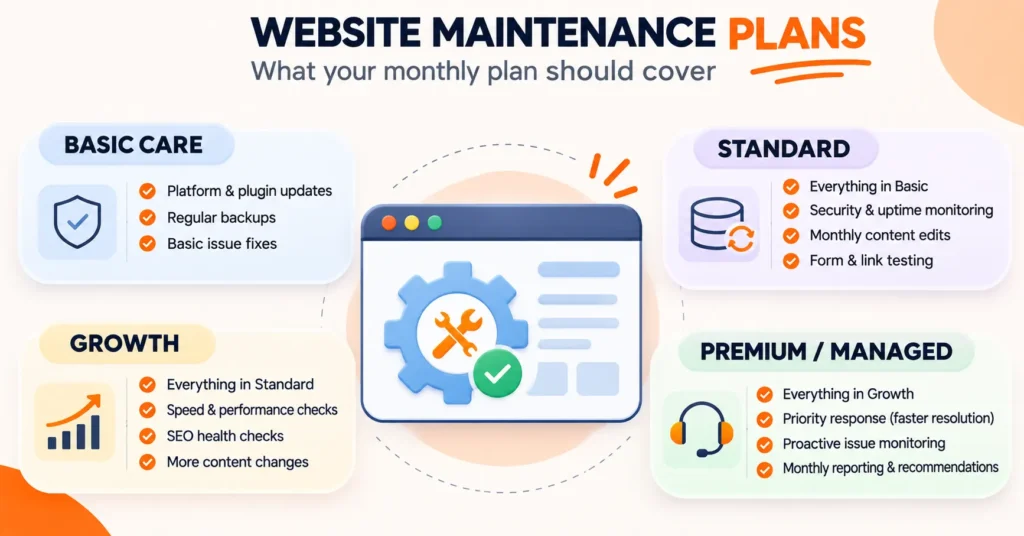
Website maintenance plans in India usually come in four tiers: basic care at ₹2,000 to ₹5,000 a month, standard at ₹5,000 to ₹15,000, growth at ₹15,000 to ₹30,000, and premium or managed plans from ₹30,000 upwards. The jump between tiers is mostly response time, the number of content changes included, and whether SEO and performance work is part of the deal.
Use this as a benchmark when you compare quotes. Prices are monthly, before 18% GST.
| Basic care | Standard | Growth | Premium / managed | |
|---|---|---|---|---|
| Typical price | ₹2,000 – 5,000 | ₹5,000 – 15,000 | ₹15,000 – 30,000 | ₹30,000 – 1,20,000+ |
| Best for | Static sites, blogs, brochure sites | Business sites with regular updates | Sites that generate leads or sales | Stores, portals, high-traffic sites |
| Core, theme and plugin updates | Yes | Yes | Yes | Yes, tested on staging first |
| Backups | Weekly | Daily | Daily, stored off-site | Daily or hourly, tested restores |
| Uptime and malware monitoring | Basic | Yes | Yes, with alerts | 24/7 with incident response |
| Content changes included | 1–2 hours | 3–5 hours | 8–10 hours | Custom or dev hours |
| Speed and Core Web Vitals | Occasional | Monthly check | Monthly fixes | Continuous tuning |
| SEO health (broken links, indexing, redirects) | No | Basic | Yes | Yes, with reporting |
| Form, checkout and payment testing | No | Forms | Forms and checkout | Full flow testing |
| Support response | 2–3 working days | 1–2 working days | Same day | Within hours, with an SLA |
| Monthly report | No | Short summary | Yes | Yes, with a review call |
Two cautions when you read any price list.
- “Support included” means nothing without hours. Ask how many hours of changes are covered each month, and what happens when you go over. Many plans cap changes at two to five hours and then charge by the hour. Freelancer rates for extra work typically run ₹500 to ₹2,000 an hour.
- Annual plans cost less per month. Providers often discount a yearly commitment and add priority support. It is worth it if you already know the provider, and risky if you do not.
How Does Website Maintenance Cost Differ by Platform?
WordPress and WooCommerce need the most hands-on maintenance, Shopify shifts part of the work to Shopify but adds app and subscription costs, and static HTML sites are the cheapest to look after. The platform decides how many updates arrive, how large the attack surface is, and who is responsible for what.
| Platform | Maintenance (₹ per month) | Main workload | Watch out for |
|---|---|---|---|
| Static HTML site | 1,000 – 5,000 | Content edits, hosting, backups of files | Every change is manual, so edits cost developer time |
| WordPress business site | 3,000 – 15,000 | Core, theme and plugin updates, security, backups | Outdated or abandoned plugins |
| WordPress with blog and SEO | 8,000 – 25,000 | Updates, speed, SEO health, content support | Plugin bloat slowing the site |
| WooCommerce store | 8,000 – 30,000+ | Security, payments, stock, checkout and plugin conflicts | Updates that break checkout |
| Shopify store | 4,000 – 30,000 | Theme and app updates, catalogue, speed, conversion fixes | App costs stacking up each month |
| Custom or headless site (Next.js, Astro and similar) | 5,000 – 25,000 plus dev hours | Package upgrades, build pipeline, hosting, monitoring | Needs a developer, not a plugin |
| Website builders (Wix, Squarespace and similar) | Low, mostly the platform subscription | Content changes, plan renewals | Limited control and less room for SEO work |
WordPress website maintenance cost
A WordPress business site typically costs ₹5,000 to ₹15,000 a month to maintain, and a simple one can be cheaper. Most of that pays for safe updates, security scans and backups. WordPress is popular, so it is also a popular target. Plugins are the most common way attackers get in, which is why updates are tested and applied on a schedule, not left for later.
If you run many plugins, a page builder and a heavy theme, expect the plan to sit higher in the range. Each extra plugin is one more thing to update, test and secure.
Static and HTML website maintenance cost
A static HTML website is the lowest-maintenance option. There is no database or admin login to attack, and hosting is cheap. Plans for static sites often start around ₹1,000 to ₹2,000 a month, and some include hosting and backups.
The catch is editing. With no content management system, even a phone number change needs someone who can edit code. If you change content often, you may spend more on small edits than you save on maintenance. A static site also still needs its domain, SSL and hosting renewed on time.
Shopify website maintenance cost
Shopify handles hosting, security patches and platform updates. That is a real saving. What you still pay for is the Shopify subscription (from a few hundred rupees a month on the Starter plan to ₹30,000 or more on Advanced, plus 18% GST), apps, transaction fees and the work of keeping the store healthy.
A light Shopify maintenance retainer of ₹4,000 to ₹8,000 a month covers small updates and monitoring. Stores that run new collection drops, theme tweaks and conversion work often spend ₹15,000 to ₹30,000. Apps are the hidden cost here. A typical growth-stage Indian store spends ₹2,000 to ₹8,000 a month on them, and every app can slow the store down.
Ecommerce website maintenance cost (WooCommerce and others)
An online store has more that can go wrong, and each failure costs money straight away. A broken checkout, a payment gateway error or a stock sync issue means lost orders. Indian guides put WooCommerce maintenance at roughly ₹5,000 to ₹20,000 a month for many stores, and stores with larger catalogues, custom integrations or heavy traffic often pay ₹10,000 to ₹40,000.
Ecommerce plans should include payment and order flow testing, security scans, PCI-aware hosting settings, stock and catalogue support, and performance tuning before sale seasons. If you are comparing quotes, check that checkout testing is in writing.
Custom, headless and modern framework sites
Sites built with frameworks such as Next.js or Astro have a smaller public attack surface and fewer urgent updates, because there is no plugin ecosystem to exploit. They still need code packages upgraded, builds monitored and hosting managed. The work is cheaper to run per month but it needs a developer, so the hourly rate matters more than the plan price. Budget ₹5,000 to ₹25,000 a month, plus hours for new features.
What Are the Fixed Yearly Costs: Domain, Hosting, Email and SSL?
Domain, hosting, business email and SSL are separate from your maintenance fee, and together they usually add ₹3,000 to ₹30,000 a year for a small or mid-size site. Larger stores on cloud hosting pay more. Always ask whether a maintenance quote includes these or leaves them out.
| Cost | Typical amount in India | Notes |
|---|---|---|
| Domain (.in or .com) | A few hundred rupees to about ₹1,500 a year | Renewal price can be higher than the first-year offer |
| Shared hosting | From about ₹2,000 to ₹10,000 a year | Fine for small sites with modest traffic |
| Cloud or VPS hosting | ₹10,000 to ₹50,000+ a year | Better speed and uptime for stores and busy sites |
| Dedicated hosting | ₹20,000 to ₹80,000 a year | For heavy or sensitive workloads |
| Business email | Per user, per month | Google Workspace and Zoho Mail are common choices |
| SSL certificate | Free with most good hosting | Paid SSL is rarely needed for small business sites |
| Premium plugins, themes and apps | ₹2,000 to ₹20,000+ a year | Licences renew every year or month |
| GST on services | 18% | Added on top of most agency invoices |
Watch the renewal price. Many providers advertise a very low first-year rate, then charge much more at renewal. Ask for the renewal cost in writing before you sign up. Also check that the domain and hosting accounts are registered in your name, not your developer’s.
Should You Pick a Monthly Plan, an AMC, Hourly Support or Pay Per Change?
A monthly plan or AMC suits any site that brings in enquiries or sales. Pay per change only suits a stable site that rarely changes, and only if someone is still responsible for updates and backups. The right model depends on how often you change the site and how much downtime would hurt.
| Model | How it works | Best for | Main risk |
|---|---|---|---|
| Monthly retainer | Fixed fee each month for a set scope and hours | Sites that update often or drive leads and sales | You pay even in quiet months |
| AMC (annual maintenance contract) | One yearly contract, often with a discount | Stable business sites and long-term clients | Locked in if service quality drops |
| Hourly or pay as you go | You pay for each task | Sites that rarely change | Slow response and no one watching in between |
| Pay per change | You request an edit and pay for it | Very stable brochure sites | Nobody owns security, backups or renewals |
If you choose pay per change, agree three things up front: who renews the domain and hosting, who applies software updates, and how backups are taken and stored. Without that, the site can go months with no one looking at it, and the first sign of trouble is a hack or an outage.
What Affects Website Maintenance Pricing?
Maintenance pricing depends on seven things: platform, site size, traffic, how often content changes, security needs, response time and the number of integrations. Knowing these helps you read a quote and spot what is missing from it.
- Platform and technology. WordPress with many plugins costs more to maintain than a static site. Custom code needs developer hours, not a plugin update.
- Size and complexity. A 10-page site and a 2,000-product catalogue are different jobs. Memberships, bookings, multilingual setups and custom features all add work.
- Traffic and uptime needs. Busy sites need stronger hosting, caching and monitoring. Sites that earn money every hour need faster response when something breaks.
- Content update frequency. A site that changes weekly needs more included hours than one that changes twice a year.
- Security and compliance. Stores that handle customer data and payments need firewalls, malware scans and stricter access control. A single breach can cost a small Indian business several lakhs, so this is the last place to cut corners.
- Response time. A plan that promises an answer in two hours costs more than one that replies in two days, because someone has to be on call.
- Integrations. Payment gateways, CRMs, ERPs, WhatsApp tools, shipping APIs and analytics scripts each add something that can break after an update.
Hosting matters too. Better hosting raises the yearly cost slightly, but it often lowers the maintenance workload by reducing crashes and slowdowns.
What Happens If You Do Not Maintain Your Website?
An unmaintained website does not fail slowly and politely. It usually fails on one bad day, and fixing it then costs more than a year of maintenance. These are the most common failure points.
- An outdated plugin lets attackers in. Hacked sites get malware, spam pages and redirects. Cleanup, lost rankings and a Google security warning can follow.
- An expired domain or SSL certificate takes the site offline. Visitors see a browser warning or nothing at all, and you may lose the domain.
- A contact form silently stops sending enquiries. You lose leads for weeks and only find out when someone mentions it.
- Pages slow down as images and plugins pile up. Slow pages lose visitors and weaken search rankings.
- A bad update or accidental change cannot be undone. Without a working backup, you rebuild from scratch.
- Broken links and old content pile up. Visitors hit dead ends and search engines see a neglected site.
- Tracking quietly stops. Analytics, Search Console or ad pixels break, and you spend months making decisions on missing data.
The maths is simple. Recovering from a hack or a lost site can run into lakhs. One Indian agency puts the average cost of a security breach for a small business at ₹3 to ₹10 lakh, and the lost business comes on top of that. A maintenance plan costs a small fraction of this.
DIY, Freelancer or Agency: Who Should Maintain Your Website?
Do it yourself only for content edits. Hire a freelancer for a simple site you can supervise, and an agency when the site earns revenue or you need guaranteed response times. Updates, backups and security are the parts to hand to someone who checks them on a schedule.
| Option | Typical cost (₹ per month) | Strengths | Weaknesses |
|---|---|---|---|
| DIY | 0, plus your time | No fee, full control | Easy to miss updates and backups, and no one to call in a crisis |
| Freelancer | 2,000 – 15,000 | Affordable, personal | One person means limited cover during leave or illness |
| Agency | 5,000 – 40,000+ | Team cover, defined response times, reporting | Higher cost, so check the scope carefully |
| Platform support (Shopify, Wix and similar) | Included in subscription | Handles hosting and platform security | Does not cover your content, SEO or apps |
If you handle content yourself, a visual editor is enough. The risk is everything behind it: a missed security update or a backup that was never tested.
How Do You Choose the Right Website Maintenance Plan?
Compare plans on what is included, not on the monthly price. Two quotes of ₹5,000 can mean very different amounts of protection. Check these seven points before you sign.
- Response time for urgent problems. Ask for it in hours, in writing. “Priority support” on its own means nothing.
- Backup frequency, location and restore tests. Daily backups stored off the server, with a restore test at least once a year.
- Security and uptime monitoring. Who gets the alert when the site goes down, and how fast do they act?
- Included content changes. The number of hours or edits per month, and the rate for extra work.
- Who manages domain, hosting and SSL renewals. And whose name the accounts are in.
- A monthly report. A short summary of updates applied, issues fixed, uptime and speed.
- Ownership. Every account, from domain to hosting to analytics, stays in your name with you as the owner.
Hidden costs to ask about
- Renewal prices that jump after the first year
- Charges for restoring a backup or cleaning malware
- Hourly rates once you exceed the included hours
- Paid plugin, theme and app licences that renew every year
- Extra fees for staging sites, CDN or premium hosting
- 18% GST on the final bill
Red flags
- A very low price with no list of what is included
- No named person or ticketing system for support
- Admin accounts and hosting held in the provider’s name
- A refusal to share backup or monitoring details
- Pressure to sign a long contract before you have seen a report
What if your developer has stopped responding?
If the domain and hosting are in your name, another provider can take over after a health check of the site. If they are not, your first job is to recover access to those accounts. Start with the domain registrar, since whoever controls the domain controls the website. Then ask the new team to audit the site before you commit to a plan.
Website Maintenance Checklist: What to Do Monthly, Quarterly and Yearly
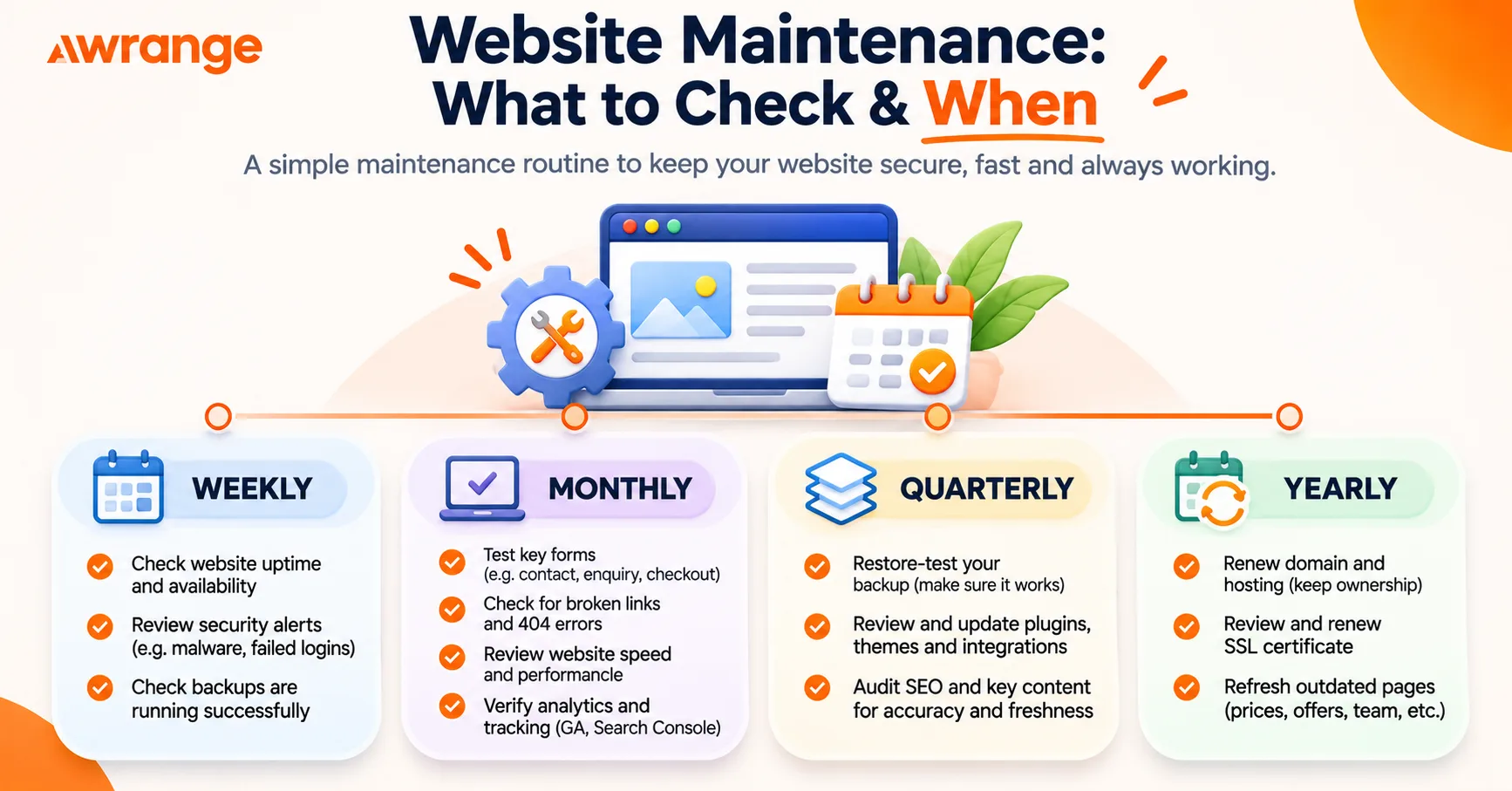
A simple routine keeps most sites healthy: quick checks every month, a deeper review every quarter and a full audit once a year. Use this list to run it yourself or to check what your provider is actually doing.
Every month
- Apply core, theme and plugin updates after a backup
- Confirm the latest backup exists and is complete
- Test contact forms, enquiry emails and the checkout
- Check uptime and security scan reports
- Run a speed test on the home page and a key page
- Look for broken links and 404 errors in Search Console
- Update prices, offers, team and contact details
Every quarter
- Remove unused plugins, themes and old admin users
- Clean up the database, spam comments and unused images
- Review Core Web Vitals and fix the slowest pages
- Check Google Analytics, Search Console and ad pixel tracking
- Review top pages for outdated facts and refresh them
- Test the site on mobile and in two or three browsers
Every year
- Renew the domain, hosting, SSL and software licences
- Run a full backup restore test on a staging copy
- Audit user roles, passwords and two-factor login
- Review hosting performance and whether to upgrade
- Do a full SEO and content audit
- Review the maintenance plan against how the site is actually used
Does Website Maintenance Affect SEO and Google Rankings?
Yes. A neglected site loses rankings through slow pages, broken links, expired security certificates and outdated content, all of which search engines and AI answers treat as signs of low quality. Maintenance protects the ranking you already earned.
Here is how the work links to search performance.
| Maintenance task | SEO effect |
|---|---|
| Speed and Core Web Vitals fixes | Faster pages keep visitors and support rankings |
| Broken link and 404 cleanup | Stops wasted crawling and dead ends for users |
| SSL and security monitoring | Avoids browser warnings and hacked-site flags in search |
| Uptime monitoring | Frequent downtime can slow crawling and drop pages |
| Content refreshes and updated dates | Keeps pages relevant for searches and AI answers |
| Redirect and sitemap checks | Keeps new and moved pages indexed |
| Analytics and Search Console checks | Keeps the data you use to make decisions |
| Mobile and layout testing | Protects the mobile experience Google indexes first |
If SEO matters to your business, ask whether the plan includes technical SEO health checks, or if that sits in a separate SEO service. Agencies that do both can fix an issue the day it appears, not when the next report is due.
Why Businesses Choose Awrange for Website Maintenance
Awrange is a Pune digital marketing agency that has maintained websites for 600+ businesses since 2017, across WordPress, custom-coded and ecommerce sites. Our website maintenance service covers updates, backups, security monitoring and small content changes, with response times that match how urgent the issue is.
What that looks like in practice:
- One team for the site and the marketing. The people who maintain your site also understand SEO, speed and conversion, so fixes do not undo your rankings.
- We build and maintain. Our WordPress development and website development teams know how the site was put together, so repairs are faster.
- Accounts stay in your name. Domain, hosting and analytics belong to you.
- A rating clients can check. Awrange holds a 5.0 rating on Google from 241+ reviews.
- Ecommerce experience. We work on stores too, including Little Minds at Work, where the store ranked #1 for its products after our SEO work.
“A website is like a shop. Launch day is the opening, and maintenance is everything that keeps the doors open and the lights on. Most of the emergencies we get called for could have been caught by a monthly check.”
Rahul, CEO, Awrange
Not sure what plan your website needs?
Send us your site address and we will review it and suggest a plan that fits, with the cost and scope written down.
Website Maintenance Cost in India: Frequently Asked Questions
How much does website maintenance cost in India per month?
Most businesses pay ₹3,000 to ₹25,000 a month. A small business site costs about ₹3,000 to ₹10,000, a larger business site ₹8,000 to ₹25,000, and an online store ₹10,000 to ₹40,000 or more. Prices exclude 18% GST, and domain and hosting are usually billed separately.
How much does WordPress website maintenance cost in India?
A WordPress business site typically costs ₹5,000 to ₹15,000 a month, and a simple one can cost less. Sites with many plugins, a blog and SEO work cost ₹8,000 to ₹25,000. Most of the fee pays for tested updates, security scans and backups.
What does Shopify or ecommerce website maintenance cost?
Shopify maintenance runs about ₹4,000 to ₹30,000 a month on top of Shopify’s own subscription and your apps. WooCommerce and other ecommerce stores run about ₹8,000 to ₹40,000, depending on catalogue size, integrations and traffic.
How much does static or HTML website maintenance cost?
Static HTML sites are the cheapest to maintain, often ₹1,000 to ₹5,000 a month. There is no database to attack, but every content change needs a developer, so frequent edits push the cost up.
Does a small website really need maintenance?
Yes. Even a five-page site needs its domain and SSL renewed, software updated, backups taken and forms tested. A small site can run on a light yearly budget of roughly ₹6,000 to ₹30,000 including domain and hosting, as long as someone is responsible for security.
What does a website maintenance plan include?
A standard plan includes software and plugin updates, backups, uptime and security monitoring, speed checks, form and link testing, a set number of content changes and support. Higher plans add SEO health checks, faster response times and monthly reports.
Can I maintain my website myself?
You can handle content changes with an editor. Updates, backups and security are better left to someone who checks them on a schedule, because a missed update or an untested backup is the usual cause of a serious problem.
Are domain and hosting included in the maintenance cost?
Usually not. Domain, hosting, business email and premium plugin licences are normally billed separately, typically ₹3,000 to ₹30,000 a year for a small or mid-size site. Ask for them to be listed in your quote.
What is a website AMC?
AMC stands for annual maintenance contract. You pay for a year of maintenance under one agreement, often at a discount compared with monthly billing. Check the scope, response times and exit terms before you sign.
Does website maintenance include SEO?
Basic plans cover technical health such as speed, broken links and security. Ongoing SEO, such as keyword work and content, is usually a separate service. Higher plans may include SEO health checks and reporting.
My developer is not responding. What can I do?
If the domain and hosting are in your name, another provider can take over after a health check. If they are not, recover access to the domain registrar and hosting account first. Then have the site audited before you commit to a new plan.
How often should a website be maintained?
Security monitoring and backups should run continuously or daily. Updates and speed checks are best done monthly. Deeper reviews of content, tracking and plugins belong every quarter, with a full audit once a year.
We Build Affordable
Websites That Help Your Business Grow Online
+91-9307-999-777Chat on WhatsAppEnquire NowRelated Blogs

Instagram Marketing Agency in Pune 2027: Services and Pricing
Instagram has over 362 million users in India, making it the country with the largest Instagram audience in the world. […
Read More
SEO, AEO and GEO in 2027: Winning Visibility in Google and AI Answers
Summary Search is no longer limited to a list of links. People are finding information through Google results, direct an…
Read More
Digital Marketing Agency Pricing in India 2027: Complete Cost Guide
Most businesses in India go through two or three agencies before finding one that actually delivers results. The ones wh…
Read More